





Digital Pathology as a Teacher: Building India’s Next Generation of Onco-Pathologists
India is currently navigating a paradox in modern medicine. While the nation has emerged as a global pharmacy and a hub for medical tourism, the internal diagnostic infrastructure faces a silent, structural crisis. Currently, India is facing a severe pathologist shortage. When we narrow this lens to oncology subspecialists—those capable of deciphering the complex cellular architecture of rare carcinomas—the numbers become even more alarming. As the cancer burden in India continues to climb, the traditional model of pathology education, which relies on physical proximity to glass slides and multi-headed microscopes, fails to suffice.
The bottleneck is not a lack of talent, but a lack of access. Digital pathology stands as the most scalable fix to this education deficit. By decoupling the slide from the microscope, we can democratize expertise, allowing a student in a rural medical college to learn from the nation’s leading onco-pathologists. In this context, digital pathology is not just a tool for diagnosis; it is the ultimate teacher, bridging the gap between urban centers of excellence and the vast educational needs of India.
The Growing Specialist Gap in Oncopathology
India’s Pathologist-to-Patient Ratio — A Critical Concern
The diagnostic backbone of oncology is pathology. However, the sheer volume of patients in India overwhelms the existing workforce. With a population exceeding 1.4 billion, the scarcity of trained professionals leads to delayed reports and, consequently, delayed treatment. In a field where hours matter, the human resource deficit is the single greatest hurdle to cancer care.
Shortage Statistics Across States
The shortage is not uniform. While metropolitan hubs like Delhi, Mumbai, and Bangalore have a concentrated presence of specialists, other states report a devastating scarcity. In many Tier-3 cities, a single general pathologist may be responsible for every biopsy in a 100-mile radius, leaving little room for the deep, focused study required for oncology. The education sector requires a radical digital intervention to ensure that every medical student has access to high-quality oncological cases regardless of their physical location in India.
Why Oncopathology Requires Specialised Training
Oncology is no longer about simply identifying cancer. It is about molecular profiling, grading, and identifying predictive markers that dictate the course of a patient’s life.
Oncology vs General Pathology Complexity
In general pathology, a practitioner might identify an infection or a benign growth. Oncology, however, requires the interpretation of subtle cellular changes that determine whether a patient receives chemotherapy or targeted immunotherapy. This complexity demands thousands of hours of viewing specific tumor types—exposure that is often unavailable in smaller India-based teaching hospitals.
Subspecialty Demand — Haematopathology, Neuropathology
The demand for subspecialties like haematopathology and neuropathology is surging. These fields require niche expertise to differentiate between similar-looking lymphoid malignancies or brain tumors. Digital platforms allow for the creation of virtual mini-fellowships in these areas, overcoming the physical limitations of hospital-specific slide archives.
What Is Digital Pathology and How Does It Work?
From Glass Slides to Gigapixel Images
The transition from traditional to digital pathology begins with the conversion of a physical specimen into a high-resolution digital data file.
How WSI Scanners Digitise Glass Slides
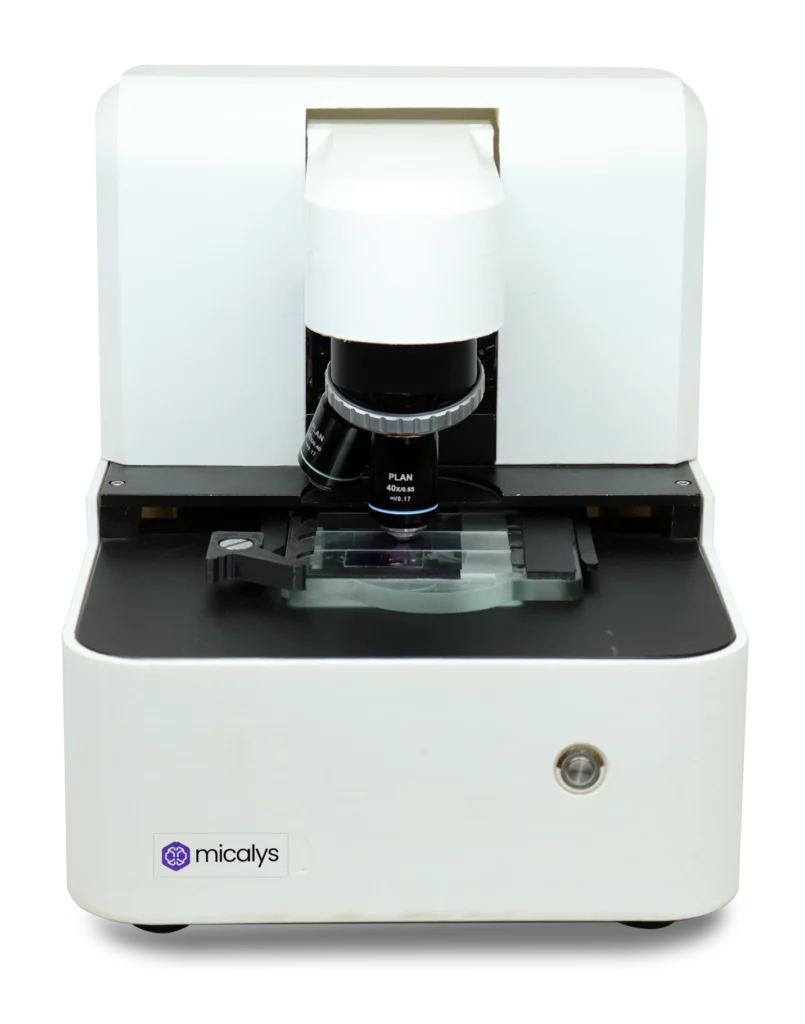
Whole Slide Imaging (WSI) scanners capture thousands of individual high-power fields and stitch them together into a single, seamless gigapixel image. This digital file replicates the experience of moving a microscope stage, but with the added benefits of instant zoom and side-by-side comparison.
Resolution Standards — 40x Optical Equivalent
For pathology education to be effective, clarity is non-negotiable. Modern scanners can achieve a 40x objective for scanning, ensuring that nuclear details and mitotic figures—critical for onco-pathology—are crystal clear for the student during their education.
Whole Slide Imaging (WSI): The Core Technology
WSI is the foundation of the digital classroom. It allows for a single rare case to be viewed by 500 students simultaneously, rather than one student at a time huddled over a microscope.
Metadata and Annotation Tools for Educators
One of the most powerful features for an education professional is the ability to annotate. A teacher can circle a specific group of cells, attach a note explaining the morphology, and link it to the patient’s clinical metadata, creating a rich learning experience in pathology.
How Digital Slide Repositories Are Transforming Medical Education
Curated Case Libraries for Structured Learning
In the traditional model, a student’s learning is limited to the cases that happen to walk through the hospital doors that month. Digital repositories change this dynamic.
Structured Case Libraries by Tumour Type
Institutions can now build curated libraries categorized by organ system and tumor type, ensuring that every student in India sees the full spectrum of oncological disease before they graduate.
Rare Tumour Archives for Advanced Training
Rare tumors might only be seen once every five years in a standard lab. In a digital archive, these once-in-a-career cases become permanent teaching assets available to every resident, making digital pathology a constant teacher.
Enabling Remote Mentorship Across Geographies
Digital pathology erases the borders between the prestigious institutes of New Delhi and small medical colleges in rural India.
Asynchronous vs Live Mentorship Models
Students can review slides at their own pace (asynchronous) or participate in a live, virtual session where a senior consultant shares their screen and walks the group through a difficult diagnosis in real-time.
Platforms Supporting Synchronous Slide Review
Modern cloud platforms allow multiple users to navigate the same slide together. This collaborative education model fosters a community of learning that was previously impossible in traditional pathology setups.
Real-World Impact — Digital Pathology in Indian Medical Colleges
Medical Colleges Piloting Digital Pathology Programs
Several forward-thinking institutions in India are already integrating these technologies to enhance their education standards. Private colleges are also partnering with technology providers to build smart labs that prioritize digital proficiency in pathology.
Student Outcomes — Improved Diagnostic Accuracy
Data suggests that students trained with digital aids develop a more nuanced understanding of spatial patterns in tissue compared to those using only traditional microscopes.
Pre- vs Post-Digital Training Assessment Data
Internal assessments show that when students use digital tools to annotate and measure features, their diagnostic accuracy improves. This measurable gain proves the value of digital pathology in the education of specialists.
Examination and Competency Benchmarks
National boards are beginning to look at digital competency. Future examinations in India may well include digital slide interpretation as a core requirement for certification in oncology pathology.
Overcoming Barriers — Tier-2 & Tier-3 Cities
Infrastructure Requirements and Cost Considerations
While the benefits are clear, the digital divide in India remains a challenge that requires strategic planning and investment.
Server vs Cloud-Based Repository Options
Colleges must choose between high-cost local servers or scalable cloud-based models. In the context of India, cloud-based pathology repositories often provide the best ROI for smaller institutions, reducing the need for on-site IT maintenance.
Bandwidth Optimisation for Rural Connectivity
For digital pathology to work in Tier-3 cities, software must be optimized for varying internet speeds. Progressive loading of images ensures that the teacher can still present cases even in low-bandwidth environments, ensuring education is never interrupted.
Government Initiatives Supporting Digital Health Education
The policy landscape in India is shifting to support this education revolution through large-scale national missions.
National Digital Health Mission Alignment
The Ayushman Bharat Digital Mission (ABDM) creates a framework where digital diagnostic data can be used for both patient care and medical education. This aligns perfectly with the needs of future pathology experts.
NMC Guidelines on Technology in Medical Curriculum
The National Medical Commission (NMC) has increasingly emphasized the need for technology-integrated learning, paving the way for digital pathology to become a standard part of the MD curriculum across India.
The Future Classroom — AI-Augmented Pathology Training
Machine Learning as a Co-Teacher
Artificial Intelligence is not replacing the pathologist; it is augmenting the human teacher by providing objective insights and data-driven analysis.
Automated Pre-Screening Assists in Training
AI algorithms can highlight areas of concern on a slide, guiding the student’s eye to the most relevant features. This accelerates the learning curve for complex onco-pathology, making education more efficient.
Key Takeaways for Medical Educators
Digitalization is no longer optional. To produce competent onco-pathologists in India, we must provide them with the digital tools that reflect modern global standards. The shift to digital pathology is a shift towards a more equitable and robust education system.
How MedPrime Supports Digital Pathology Education
MedPrime Technologies is committed to bridging the diagnostic gap in India by providing accessible WSI solutions and digital platforms. Our mission is to ensure that pathology departments have the resources they need to serve as world-class teacher hubs for the next generation.
Next Steps — Integrating Digital Pathology into Your Curriculum
Start small by digitizing your rare case collection. Foster a culture where digital slides are the primary medium for multidisciplinary team meetings and resident reviews. Invest in education today to secure the future of oncology in India.
Conclusion
The journey to building India’s next generation of onco-pathologists is paved with pixels, not just glass. By embracing digital pathology as a core teacher, we can ensure that a student in any corner of India has the same quality of education as one in the world’s leading cancer centers. This digital shift is our best hope for meeting the rising oncological challenge and ensuring that no diagnosis is ever delayed by a lack of expertise.
It is time to move beyond the physical constraints of the microscope and step into the limitless potential of the digital classroom. For the student, for the patient, and for the future of India, the transformation of pathology through technology is the only path forward.
Are you ready to transform your pathology department? Contact us today to learn how our digital solutions can empower your students.