






How to Know When Your Lab is Ready for Digital Microscopes
The modern pathology lab is at a crossroads. For over a century, the manual microscope has been the gold standard, requiring physical glass slides to be prepared, stained, and manually maneuvered under a lens. However, as diagnostic demands surge, the advantages of digital microscopy are becoming impossible to ignore. Digital transformation of pathology labs is no longer a luxury for academic centers; it is a strategic necessity for labs aiming to maintain speed and accuracy in a high-pressure healthcare environment.
The Growing Need for Digital Microscopy in Pathology Labs
Increasing Slide Volumes in Modern Diagnostics
The global increase in chronic diseases and a growing aging population have led to a significant spike in biopsy and blood test volumes. Labs that once handled a manageable number of cases are now inundated with hundreds of slides daily. This volume makes manual handling a primary bottleneck in patient care.
Why Traditional Microscopy Workflows Are Becoming Inefficient
Traditional workflows rely on the physical presence of both the slide and the pathologist in the same room. This geographic dependency creates “dead time” where cases sit idle while waiting for a pathologist to become available or for a slide to be moved from the lab bench to the doctor’s desk.
Challenges of Traditional Slide Management in Pathology Labs
Manual Slide Archiving and Retrieval
The advantages of digital microscopy become most apparent when looking at the tail-end of the diagnostic process: storage.
Limited storage space
Glass slides are fragile and bulky. Regulatory requirements often mandate that these slides be kept for 10 to 20 years. For growing labs, this leads to rooms filled with filing cabinets or expensive off-site climate-controlled storage rentals.
Time-consuming slide retrieval
When a clinician requests a retrospective review or a patient seeks a second opinion, a technician must manually hunt through thousands of physical records. This can take hours, or even days, delaying critical medical decisions.
Delays Caused by Physical Slide Shipping
Physical logistics is the enemy of rapid diagnostics.
Inter-lab consultations
If a general pathologist needs a sub-specialist’s opinion, the glass slide must be packaged and shipped. This introduces a 24-to-48-hour delay at minimum, just for transit.
Risk of slide damage or loss
Glass is inherently breakable. During shipping, slides can crack, or worse, get lost in transit. A lost slide often means a lost patient sample, potentially requiring a repeat biopsy—an invasive and costly procedure.
How Digital Microscopy Solves These Challenges
What is Digital Pathology?
Before diving into the solutions, we must ask: What is Digital Pathology? It is the practice of digitizing glass slides into high-resolution images that can be viewed, managed, and analyzed on a computer. This shift allows the diagnostic process to move at the speed of the internet rather than the speed of a courier.
What is Whole Slide Imaging (WSI)?
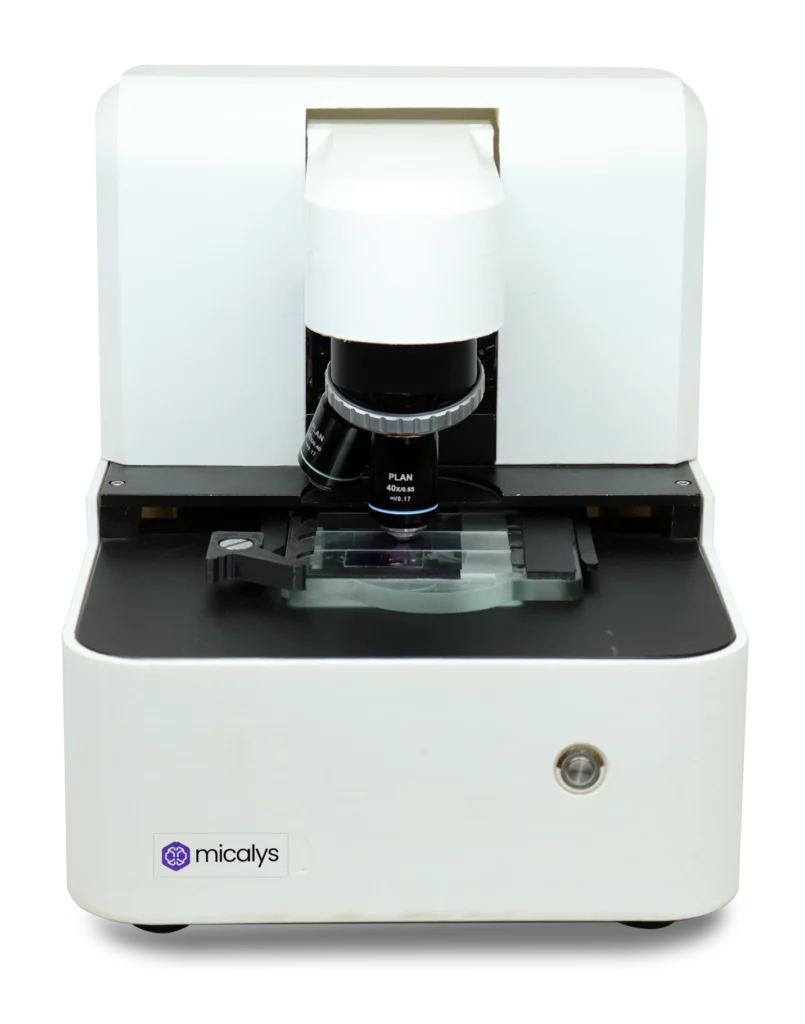
At the heart of this transformation is Whole Slide Imaging (WSI). Using a high-speed scanner like Micalys, the entire tissue area on a glass slide is captured at multiple magnification levels (usually 20x or 40x).
Digital Slide Scanning for Faster Diagnostics
One of the primary advantages of digital microscopy is the decoupling of the image from the physical slide.
High-resolution digital slide images
Modern scanners produce images that are indistinguishable from what is seen through a traditional eyepiece, often with better clarity and the ability to view multiple sections side-by-side.
Instant sharing with pathologists
Once a slide is scanned into a WSI format, it can be shared across the hall or across the globe in seconds, facilitating instant collaboration.
Handling High-Volume Workflows in Hematology and Cytology
Slide Volume Challenges in Hematology Labs
Hematology labs are among the busiest, often processing hundreds of blood smears daily. Manually searching for rare cells or performing differential counts is physically exhausting and prone to human error due to fatigue. Digital tools automate the identification of cell types, allowing the pathologist to focus only on abnormal findings.
Improving Cytology Analysis with Digital Tools
Cytology involves searching for minute cellular changes across a wide area. Digital microscopy allows for “z-stacking,” where the scanner captures multiple focal planes, ensuring that three-dimensional cell clusters are fully in focus, which is one of the key benefits of digital microscopy in specialized screening.
Reducing Long-Term Storage Costs with Digital Archiving
Physical Slide Storage vs Digital Storage
While a server has a cost, it is significantly lower than the real estate cost of a physical archive. Digital storage allows for instant retrieval and the ability to maintain millions of cases in a footprint no larger than a standard server rack.
Benefits of Cloud-Based Slide Archiving
By moving to the cloud, labs eliminate the risk of physical degradation. Digital files do not fade or break. This permanence is one of the long-term advantages of digital pathology that ensures patient records remain pristine for decades.
Signs Your Pathology Lab is Ready for Digital Microscopy
How do you know it’s time to make the switch? Look for these three signs:
Increasing diagnostic workload
If your team is struggling to keep up with daily slide volumes and the backlog pile is growing, automation is the only way to scale without exponentially increasing headcount.
Need for remote collaboration
If your lab frequently sends slides out for expert opinions or if you have pathologists who wish to work from home/satellite offices, digital pathology is the infrastructure you need.
Limited physical slide storage space
If your archive room is full and you are considering renting more space, the ROI of a digital scanner like Micalys becomes clear almost immediately.
Transform Your Lab Workflow with Digital Microscopy
Why Digital Microscopy is the Future of Pathology
As we look at what are the future trends for digital microscopy in pathology, we see a landscape dominated by Artificial Intelligence (AI). AI can only work with digital data. By digitizing now, your lab prepares for a future where algorithms help detect cancer faster and with higher precision.
Book a Demo of Micalys Digital Microscopy System
The transition to a digital workflow doesn’t have to be overwhelming. At Medprime Technologies, we specialize in helping labs navigate this change with the Micalys system.
See How Digital Microscopy Can Improve Your Lab Efficiency
Experience the advantages of digital pathology firsthand. See how high-speed scanning, instant sharing, and AI-ready images can revolutionize your diagnostic accuracy and turnaround time.